
Free playbook · PDF
Which trucks should go electric first?
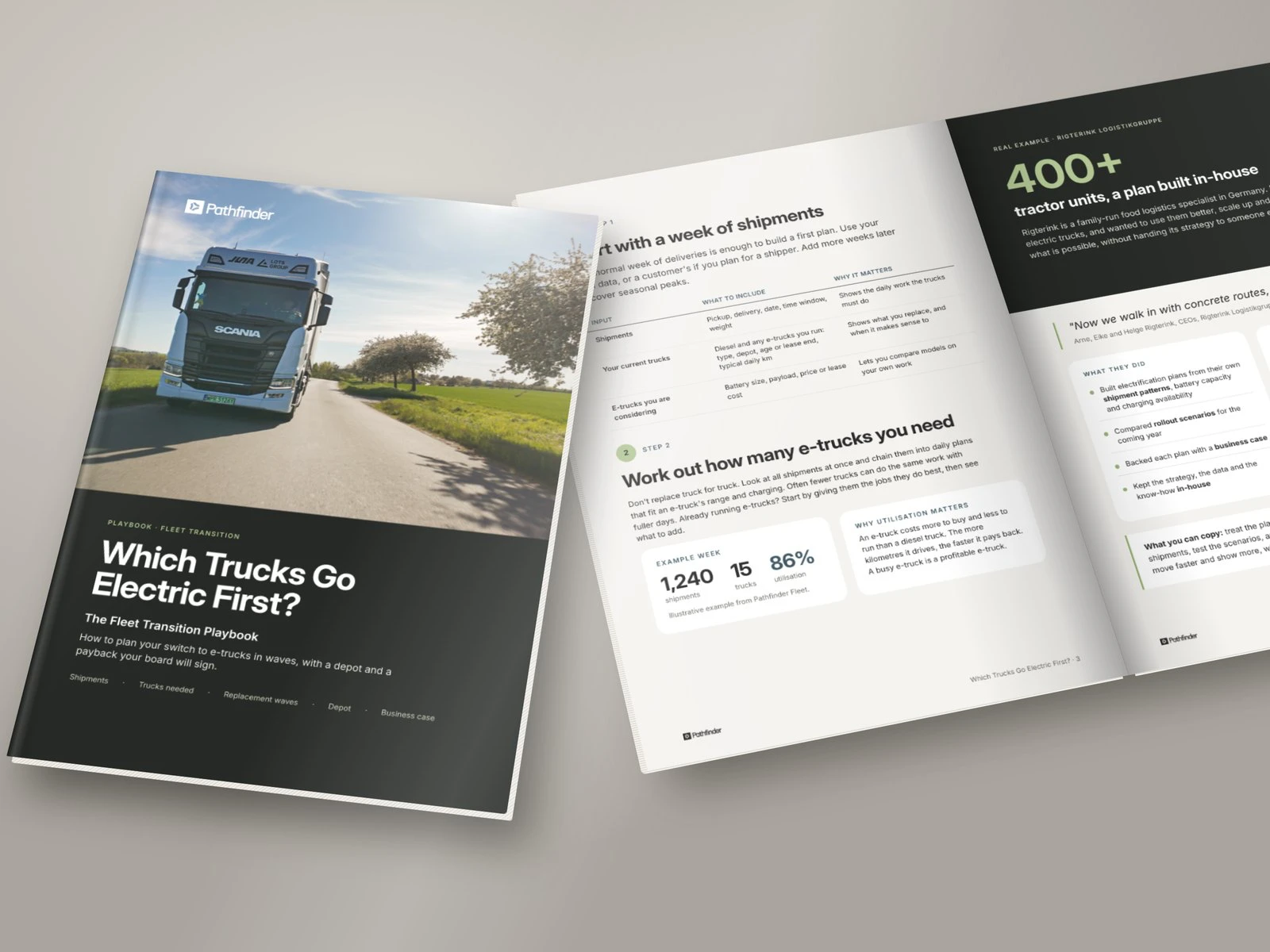
Which Trucks Go Electric First? The Fleet Transition Playbook
Plan the switch to electric trucks from your shipments, not from a truck brochure. Work out how many e-trucks the work really needs, replace them in waves starting where electric works best today, size the depot from the schedule, and back it with a business case. This free playbook walks through six steps, with a real example from Rigterink.
Get the full playbook
In short
- Plan from one normal week of shipments, not from a truck brochure.
- Don't replace truck for truck: chain all shipments into daily plans, and often fewer e-trucks do the same work.
- Replace in waves, starting with trucks whose daily km fit the range with a margin and that return to the depot every night.
- Size the depot from the schedule, not the number of trucks, and talk to the grid company early.
- Show the board at least two scenarios, lowest cost and lowest CO₂, with payback for each.
What data do you need to plan a fleet transition?
One normal week of shipments is enough to build a first plan. Use your own data, or a customer's if you plan for a shipper, and add more weeks later to cover seasonal peaks. Add the trucks you run today and the e-trucks you are considering.
| Input | What to include | Why it matters |
|---|---|---|
| Shipments | Pickup, delivery, date, time window, weight | Shows the daily work the trucks must do |
| Your current trucks | Diesel and any e-trucks you run: type, depot, age or lease end, typical daily km | Shows what you replace, and when it makes sense to |
| E-trucks you are considering | Battery size, payload, price or lease cost | Lets you compare models on your own work |
How many electric trucks do you need?
Don't replace truck for truck. Look at all shipments at once and chain them into daily plans that fit an e-truck's range and charging. Often fewer trucks can do the same work with fuller days. Already running e-trucks? Start by giving them the jobs they do best, then see what to add.
- An e-truck costs more to buy and less to run than a diesel truck
- The more kilometres it drives, the faster it pays back
- A busy e-truck is a profitable e-truck
Which trucks are the best first candidates for electric?
Replace in waves, not all at once. Start with the trucks where electric works best today, learn, then scale. Each wave can be ranked by cost, by CO₂ or a mix of both – change the priority and the order changes.
| Good first candidates | Why |
|---|---|
| Daily km fits the range with a margin | No public charging needed to start |
| Returns to the depot every night | Cheap, reliable overnight charging |
| Steady, predictable schedule | High utilisation, fast payback |
| Diesel truck is due for renewal or lease end | You replace at the natural moment, not early |
| Customer asks for low-CO₂ transport | Revenue on top of the savings |
How do you size depot charging for electric trucks?
Size the depot from the schedule, not from the number of trucks. Too few chargers and trucks wait; too many and you pay for power you don't use. Talk to the grid company early: a bigger grid connection can take a long time, and it often sets the pace of the whole transition.
| Decide | Based on |
|---|---|
| Number of chargers | How many trucks are parked at the same time, and for how long |
| Power per charger (kW) | How much energy each truck needs before its next shift |
| Total power (MW) | Chargers × power, and whether all charge at once |
| Overnight or daytime | When trucks are parked, and electricity prices by hour |
| Grid connection | What your site has today, and what the grid company can deliver |
What goes into the business case for electric trucks?
Your board doesn't buy trucks; it buys a plan with numbers it can trust. Put the numbers below on one page and show at least two scenarios, lowest cost and lowest CO₂, so the board sees the trade-off and picks instead of arguing about one number.
| Number | What it answers |
|---|---|
| Investment | Trucks, chargers and grid connection, per wave |
| Cost per km vs diesel | Energy, maintenance, tolls and road charges compared |
| Utilisation | How hard each e-truck works, which drives payback |
| Electric share | How much of the work runs electric, wave by wave |
| Payback | When the investment has paid for itself |
| CO₂ reduction | What you can report to customers and in your sustainability reporting |
| Risks | Electricity price, residual value, charger uptime, and what you do if they go wrong |
What are the most common mistakes in a fleet transition?
Most costly mistakes happen before the first truck arrives: replacing one-for-one, so utilisation and payback suffer; sizing chargers by truck count instead of by schedule; and asking the grid company too late, so the trucks arrive before the depot can charge them.
- The plan is built on your real shipments, not averages
- You know how many e-trucks you need, and their utilisation
- The depot is sized, and the grid company has confirmed capacity
- Longer routes outside the depot have been checked for charging on the way
What does a fleet transition look like in practice?
Rigterink, a family-run food logistics specialist in Germany with more than 400 tractor units, builds its electrification plans in-house from its own shipment patterns, battery capacity and charging availability. It compares rollout scenarios, backs each plan with a business case and shows shippers which lanes go electric, and when.
Read the Rigterink case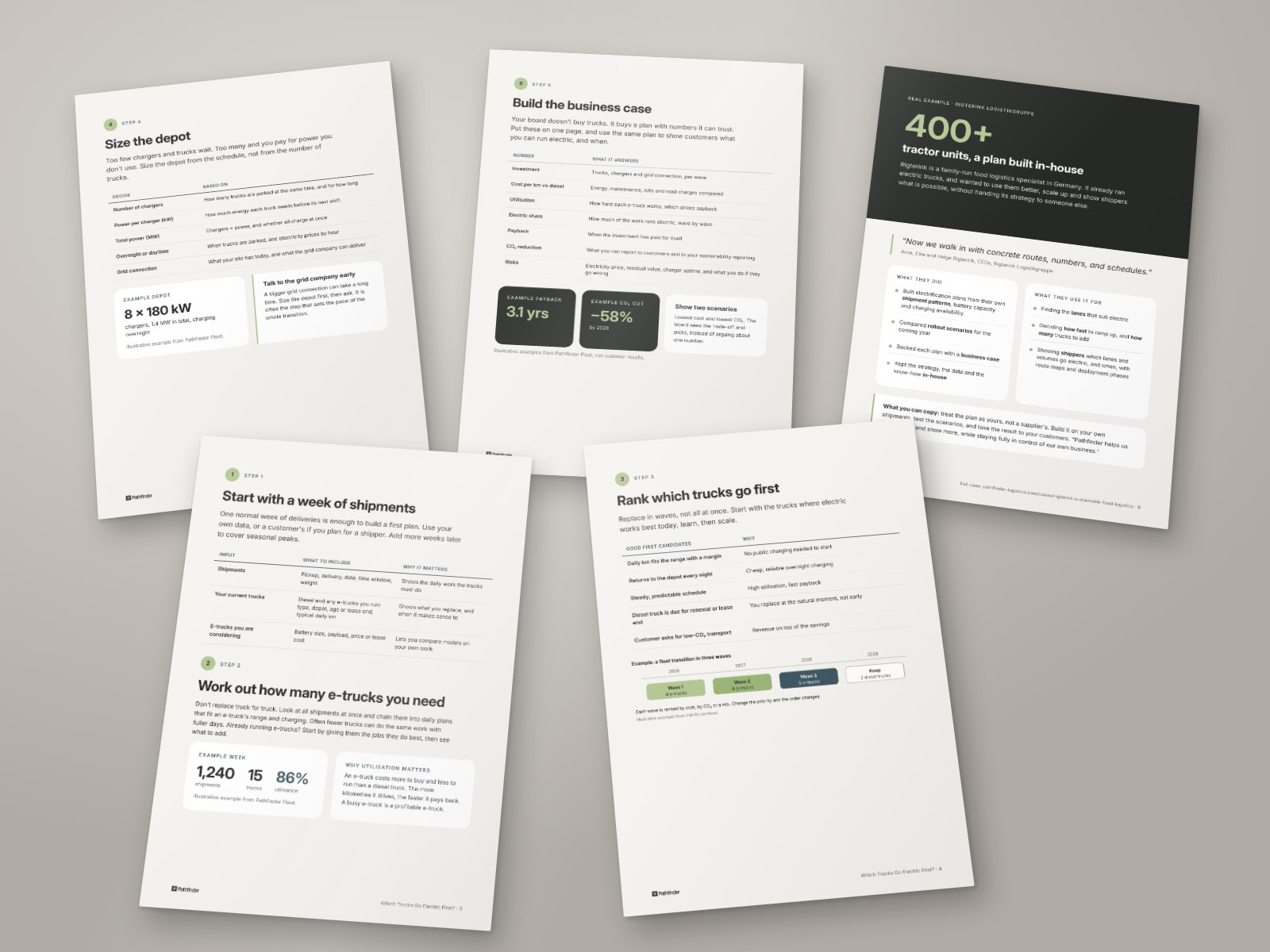
What's inside the playbook
Six steps, from a week of shipments to a plan your board will sign – the same path as Pathfinder Fleet.
- 1Start with a week of shipments – the data you need to plan, and what can wait
- 2Work out how many e-trucks you need – fewer trucks, fuller days
- 3Rank which trucks go first – replace in waves, by cost, by CO₂ or a mix
- 4Size the depot – chargers, power and when to charge
- 5Build the business case – the numbers your board will ask for
- 6Check before you buy – common mistakes, and a final checklist
Plus: a real example from Rigterink, a 400+ truck carrier that builds its plans in-house
Get the full playbookPathfinder Fleet follows the same path: upload shipments and trucks, choose cost, CO₂ or a mix, and get the plan – waves, depot and payback. Want to see it on your own shipments? Book a Fleet demo
Also in this series: The Electric Long-Haul Route Playbook
Frequently asked questions
Is the playbook free?
Yes. Enter your work email and we'll send it to you, and you can download it right away.
Who is the playbook for?
Owners of logistics companies and fleet managers who are about to invest in electric trucks, or who run a few already and want to scale.
How much data do I need to start?
One normal week of shipments is enough for a first plan. Add more weeks later to cover seasonal peaks.
Should you replace diesel trucks one for one with electric trucks?
No. Replacing every diesel truck with an e-truck is one of the most common mistakes, because utilisation and payback suffer. Look at all shipments at once and chain them into daily plans that fit an e-truck's range and charging; often fewer trucks can do the same work.
When should you contact the grid company?
Early – once the depot is sized from the schedule. A bigger grid connection can take a long time, and it is often the step that sets the pace of the whole transition.
Do I need Pathfinder to use the playbook?
No. The playbook explains how to plan a fleet transition step by step. It follows the same steps as Pathfinder Fleet, so you can book a demo and build a first scenario on your own shipments.